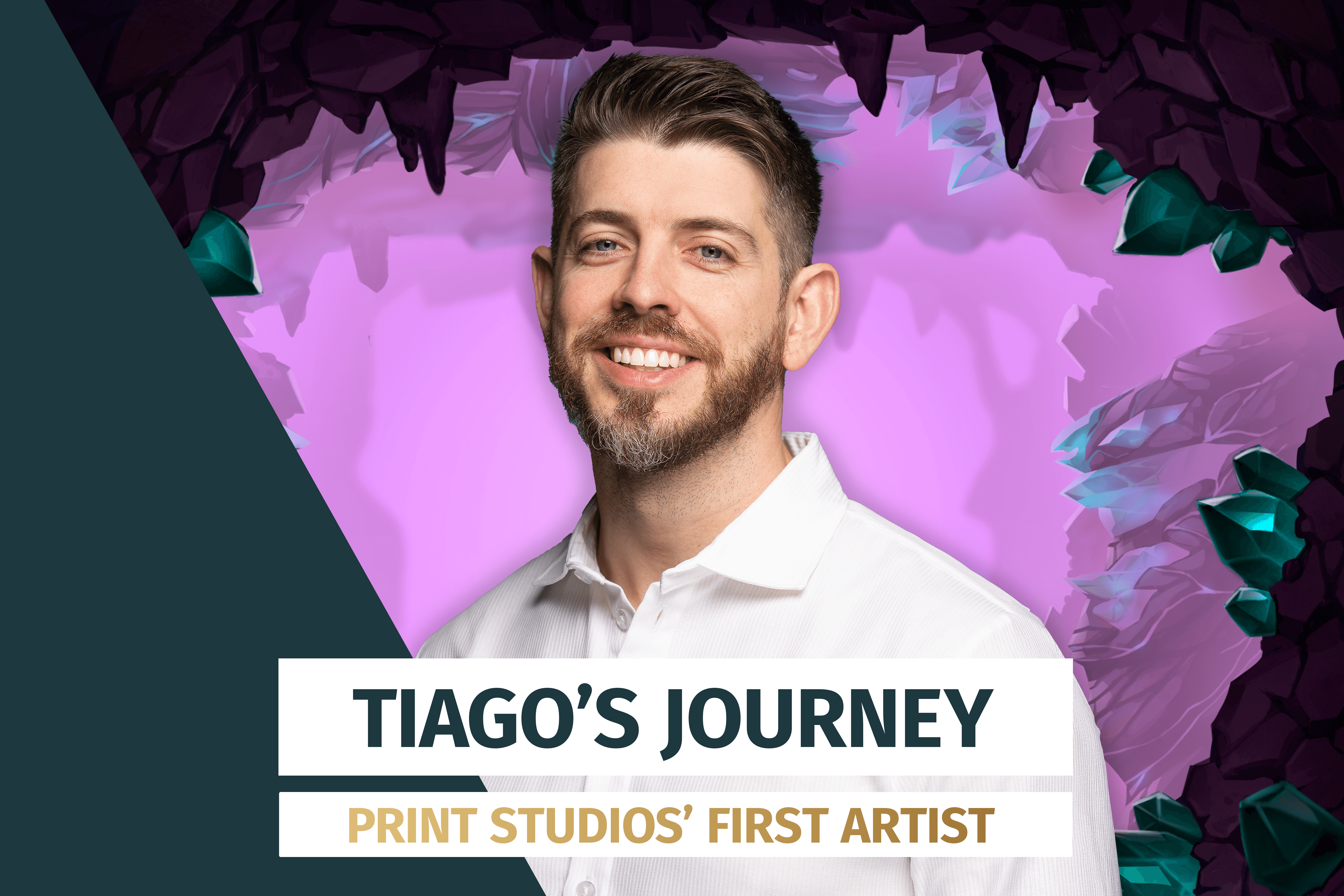
When Tiago joined Print Studios, the company was still in its earliest days. No games launched, no proven track record, just big ideas and bold ambition. Joining as the very first artist meant stepping into the unknown, but it didn’t take long for that uncertainty to turn into excitement.
“I didn’t know what to expect when I first started working with Print, because it was a new company and they had not yet launched any games. But in the first month of work, I could already tell the games would be amazing. Carl loves to come up with crazy ideas and I normally double down on them.”
That early creative chemistry would go on to define not just Tiago’s role, but Print Studios’ visual identity as a whole.
Building the First World: Crystal Golem
Tiago’s first project was creating the world of Crystal Golem, a game that remains one of his personal favourites. Armed with a loose but inspiring brief, the concept phase quickly became something special.
Carl’s references included Ori and the Blind Forest, Dota 2’s Roshan, and Pokémon’s concept of evolution, all worlds Tiago already loved. The task? Create a glowing cave environment filled with luminous flowers and a character that felt alive.
“He basically gave me three references of things that I’ve already played and loved, which made the creation of the game something really special.”
The project wasn’t without its challenges, especially when it came to UI and adapting the game across different orientations, but overall the process was smooth and set the tone for how Print Studios approaches game creation from there on.
Art That Serves the Game
One of the biggest challenges Tiago has faced, and continues to face, is something that has become a defining strength of Print Studios’ games: ensuring that art and mechanics feel truly connected.
“At Print, we’d never just copy game features that already exist. There’s always something new and challenging about creating those assets and making everything work together, as if the background is actually connected with what’s going on on the reels.”
This philosophy stands in contrast to many games on the market, where visuals and gameplay can feel disconnected. At Print, we strive to make immersion everything.
Seeing the Games Come to Life
For Tiago, one of the most rewarding moments is when everything finally clicks; animations, sound design, and gameplay coming together into a living experience.
“When we started animating the games and symbols, everything just came to life. Seeing the games with sounds and being played by streamers was a great way to know we were doing things right.”
Moreover, community feedback has only reinforced that feeling, with comments like “Print game quality standards” and “Print games are never a let down” appearing time and time again.
“That’s proof that we’re onto something great when it comes to innovation in this industry.”
Creative Freedom as a Superpower
Ask Tiago what truly sets Print Studios apart, and the answer comes quickly: creative freedom.
“Most artists are used to receiving a briefing where they’re told exactly how the game needs to look. At Print, a game’s initial idea can be completely different from the end outcome.”
That freedom to explore new ideas, themes, and styles has allowed both the games, and Tiago himself, to grow in unexpected ways.
“There’s room for exploration, new concepts, new themes… but wait, maybe I shouldn’t be telling our secret sauce.”
Looking Ahead
With multiple standout releases behind him and new projects on the horizon, including the upcoming Punk Penguin for those following Print’s roadmap, Tiago continues to play a key role in shaping the studio’s creative future.
From building the very first game world to helping define what “Print quality” means today, Tiago’s journey mirrors the evolution of Print Studios itself: bold, creative, and never afraid to push further.
And if the past is anything to go by, the best is still to come.
Published:
Jan 27, 2026


